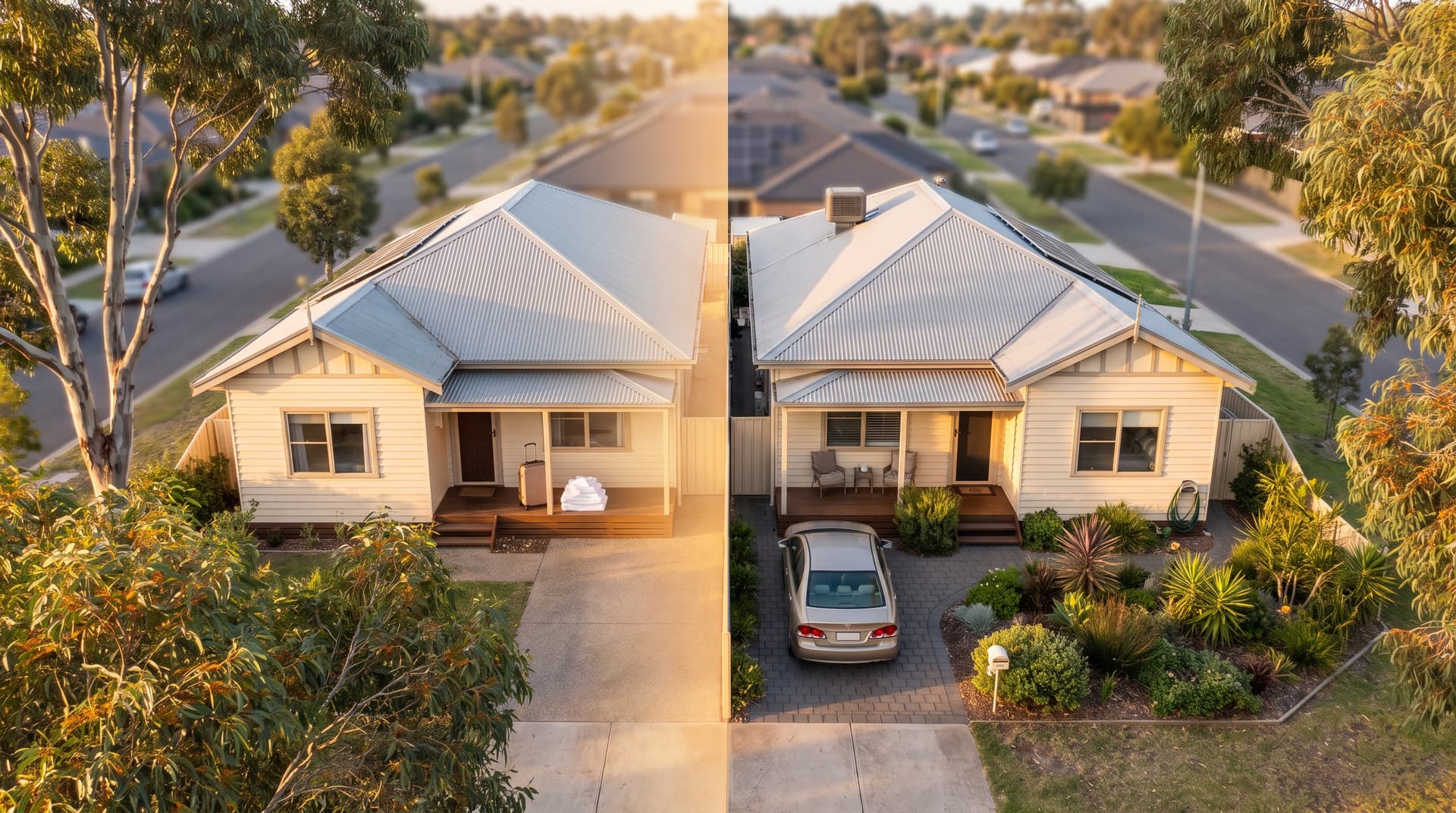
A property that grosses strong short-term rental income can appear to substantially outperform a long-term lease, until you run the actual numbers. Picki modelling found a short-term rental generated 67% less net income than a long-term rental despite grossing 71% more. The headline revenue gap is real, but so is everything that sits between gross and net.
The Money Question: Gross Income Isn't Profit
Traditional rental yields for Australian investment properties typically range between 2-5% annually. Short-term rental income through Airbnb can potentially deliver double or triple those returns in tourist-friendly locations. Those two numbers sit side by side in every forum thread and broker pitch, and they invite the wrong conclusion.
The gap is in the costs. Short-term rentals generate higher gross income but face dramatically higher operating costs: cleaning, furnishing, platform commissions, utilities, and the constant churn of guest turnover. The 80/20 rule captures the rough shape of it: property owners retain approximately 80% of rental income after deducting Airbnb management fees and operational costs. Airbnb charges hosts a service fee of approximately 3% per booking in Australia. That is before you pay a property manager, whose fees can take a significant share of gross income. Then there is cleaning between every guest, utilities running at two to three times normal residential usage, and furniture that wears out on a guest schedule, not an owner schedule.
A property with strong Airbnb bookings could retain a meaningful portion of that income before mortgage costs. The same property on a long-term lease could retain a higher proportion of the rent, with long-term leases typically requiring less hands-on management. The gross number tells you what the property can earn. The net number tells you what you keep.
Where Airbnb Genuinely Out-Earns: Location Is Everything
The numbers flip when the location is right. Tourist areas may experience 70-80% occupancy rates, creating income gaps that traditional rentals avoid through 12-month lease agreements. Demand for Airbnb rentals is increasing within Australia, with certain areas outperforming the major cities in yields.
A luxury tiny house Airbnb can deliver a gross yield of 25-40% versus 3-5% for residential. That is not a typo. The capital entry point is lower and the asset doubles as a personal weekender. Regional hotspots are where the yield gap is widest. Coastal towns with a four-month summer season and a dozen long weekends a year can sustain nightly rates that a long-term tenant would never pay.
Melbourne is the counterpoint. Its Airbnb market is the toughest in Australia but offers the highest revenue ceiling for professional operators. The city has enough year-round demand from business travellers, major events, and domestic tourism to keep occupancy viable. But the cost base is higher, the competition is fierce, and the regulatory environment is tighter than anywhere else in the country.
The takeaway is not that Airbnb beats long-term renting or vice versa. It is that the answer lives in the suburb-level data: vacancy rates, seasonal demand patterns, and the specific yield spread for that postcode. PropSpotter's research process pulls from 30-plus data sources, including vacancy rates, rental yields, and demographic shifts, to show whether a suburb works better for short-term or long-term rental before you commit capital.
The 2025-26 Regulatory Squeeze Changes the Maths
The single biggest variable in the Airbnb vs long-term rental calculation in 2026 is regulation. State governments and local councils have spent the last two years building a compliance framework that makes short-term hosting harder and more expensive.
Victoria leads the charge. The short stay levy is 7.5% of the total booking fee for any stay of fewer than 28 continuous days, in force since 1 January 2025. That comes straight off the top of every booking. Since 1 January 2025, Victorian owners corporations can prohibit short-stay accommodation by special resolution with the support of 75% of lot owners. If you own an apartment and your body corporate votes to ban short stays, your Airbnb strategy ends overnight.
Western Australia has built its own framework. The STRA register opened on 1 July 2024 and registration became mandatory from 1 January 2025. Short-term rental providers in Western Australia must register their properties before listing and taking bookings. From 1 January 2026, unhosted short-term rental properties in Perth need council approval to operate beyond 90 days.
Night caps are spreading. Airbnbs are legal in Australia but can be capped at 60 days per year, with limits on unhosted properties at 90 nights a year. Starting September 23, 2024, non-hosted rentals in some areas were capped at just 60 days per year. The 90 Day Rule restricts short-term rental operations in specific Australian jurisdictions, particularly affecting unhosted accommodation. Penalties for breaching the 90-day limit range from $1,100 to $110,000.
Beyond the state-level rules, a landmark May 20 AHURI report recommended severe restrictions on converting long-term homes into short-term rentals in Australia. Another Aussie city has flagged an Airbnb crackdown forcing investors to rethink short-term rentals. The regulatory direction is one-way. If you are modelling Airbnb returns on a five-year horizon, you need to assume the rules tighten further, not ease.
Tax, CGT and Borrowing: The Hidden Costs
The tax treatment of short-term rentals has sharpened in 2026. The ATO now has clearer rules, more data, and stronger compliance tools, and the sharing economy reporting regime means platforms report your income directly to the ATO. If your return does not match what Airbnb and Stayz have on file, you will hear about it.
Capital gains tax is where the stakes are highest. The six-year absence rule lets you treat a dwelling as your main residence for CGT purposes for up to six years after you move out. If your former home is rented through Airbnb or another short-term platform, the property may still qualify for the 6-year rule CGT exemption. That is a substantial benefit. Sell within the window and you may pay zero CGT on what could be hundreds of thousands in gains. But the rule requires you not to claim another property as your main residence during that period, and the ATO may scrutinise whether the property was genuinely available for rent on commercial terms.
On the borrowing side, lenders treat short-term rental income differently. They typically assess it at a 30-40% discount when calculating your borrowing capacity. A property that grosses $60,000 a year on Airbnb may be assessed at a discount by lenders, potentially reducing the amount counted in the bank's servicing calculator. The same property on a 12-month lease may count at close to full value. That haircut can mean the difference between qualifying for the next property and hitting a borrowing wall.
There is one tax advantage worth noting for short-term operators. A short-term let property is not considered vacant land where it was lived in for six months of the previous year, so a well-booked property avoids vacant residential land tax. Keep the calendar full and you sidestep a charge that can run into the thousands.
Why Long-Term Renting Can Still Win
Long-term renting offers consistent income with minimal turnover responsibilities, but has a lower earnings potential compared to Airbnb. The trade is straightforward: you give up the upside for predictability. For an investor who wants the mortgage covered and a quiet life, that is a good trade.
The rental crisis has added a political dimension. During the rental crisis, Airbnb and holiday home owners were urged to let out properties to long-term renters. Short-term rentals listed as Airbnbs may contribute to the rental crisis in Australia because they affect housing inventory. Policy pressure to convert short-term listings to long-term leases is not going away, and future governments may sweeten the incentive or sharpen the penalty.
There is also a structural point that gets overlooked in the yield comparison. Short-term and long-term rentals are materially different strategies, meaning one does not necessarily flow towards the other. A studio apartment in a Melbourne CBD tower is a natural short-term rental. A three-bedroom house in a family suburb is a natural long-term rental. Trying to force the wrong model onto the wrong property type produces the worst of both: low occupancy and high management overhead, or below-market rent and a tenant who treats the place like a hotel.
The 30% rule frames what tenants can actually pay: monthly rent should be no more than 30% of gross monthly income. Spending around 30% of your income on rent is generally considered the benchmark for finding the right property in Australia. That ceiling is what anchors long-term rental yields. It also means long-term rent is more resilient in a downturn. When household budgets tighten, people still need somewhere to live. They cancel the weekend away first.
The Verdict: Which Strategy Makes More Money in 2026
The answer is not Airbnb or long-term. It is which suburb, which property type, and which ownership structure.
Airbnb wins where the location delivers occupancy above 70%, the property type suits short stays (proximity to attractions, walkable, furnished well), and the owner has the time or the management budget to run it properly. The gross yield premium is real. But the costs are real too. The 80/20 rule, the 7.5% Victorian levy, the 30-40% lending haircut, and the 60-day and 90-day caps all eat into the headline number.
Long-term renting wins where the property sits in a suburb with stable tenant demand, the owner wants passive income, and the borrowing capacity matters for the next purchase. The yield is lower but the net retention is higher, the management load is lighter, and the regulatory risk is near zero.
The right answer starts with the data. Before you run the Airbnb vs long-term rental numbers, you need the vacancy rate, the seasonal occupancy curve, the yield spread, and the regulatory exposure for the specific suburb you are looking at.
Learn how to calculate rental yield properly before you compare the two models. The formula is the same for both strategies. The inputs are not.