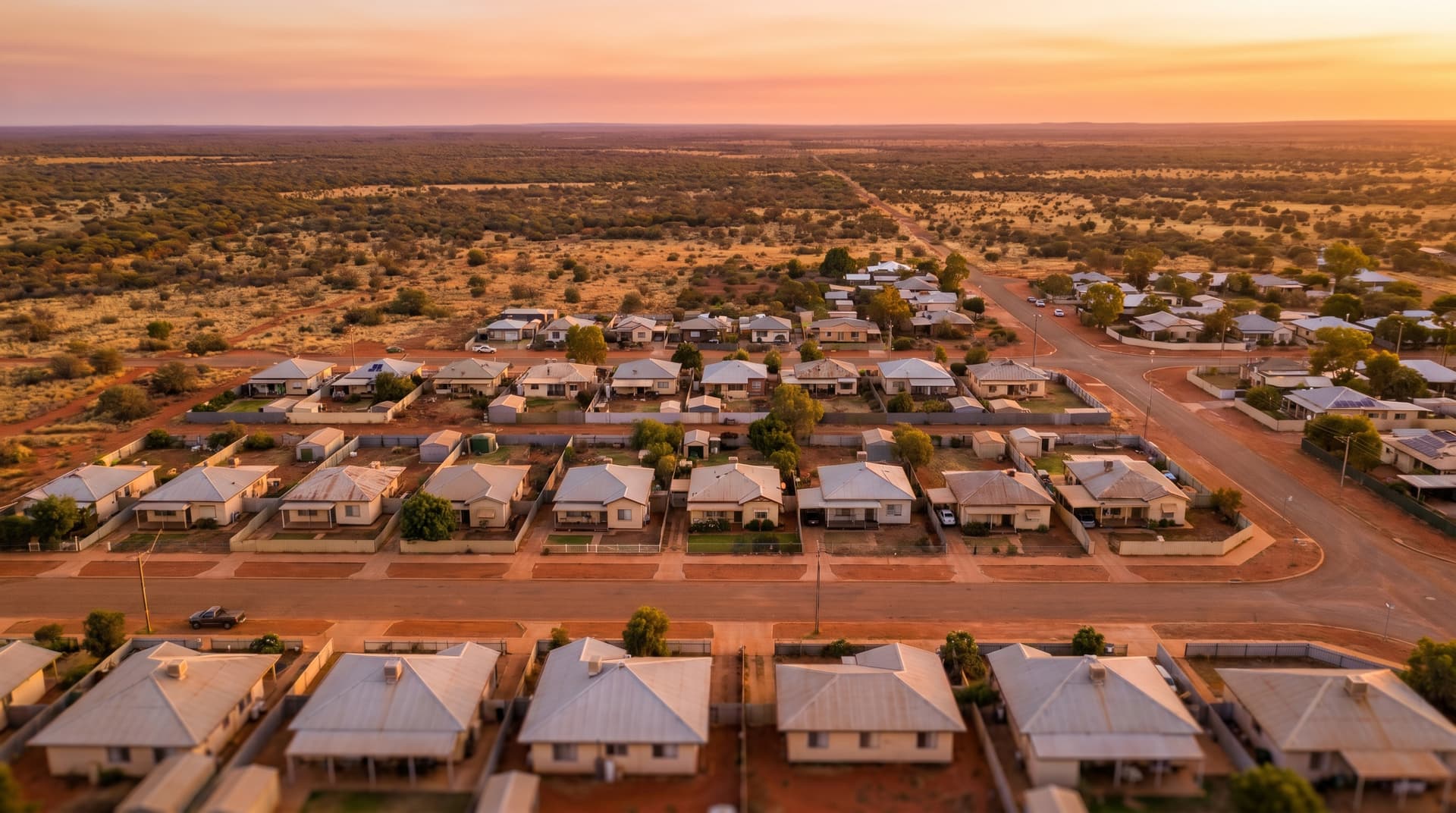
Rental yield is the metric that separates cash flow positive properties from ones that bleed money every month. With interest rates still elevated in 2026 and national gross yields compressing, finding high rental yield suburbs requires looking well beyond Sydney and Melbourne.
According to Frasers Property, Australia's national gross rental yield fell from 4.92% in Q3 2025 to 4.69% in Q1 2026. Capital city houses typically return 3% to 4.5%. Meanwhile, regional suburbs across Western Australia, Queensland, South Australia, and the Northern Territory are delivering gross yields of 7% to 12%.
This article breaks down the high rental yield suburbs worth watching in each state, with current median prices, weekly rents, and gross yields. If you need a refresher on the maths behind these numbers, our rental yield calculator guide walks through the formula step by step.
What Makes a Suburb Deliver High Rental Yield?
The formula is straightforward. Gross rental yield equals annual rental income divided by the property value, multiplied by 100. A property purchased at $200,000 that rents for $350 per week ($18,200 annually) produces a gross yield of 9.1%.
According to Picki, with the average investor mortgage rate sitting around 6.2% in March 2026, the minimum gross yield to cover interest alone on an 80% LVR loan is approximately 5.0%. Once you factor in council rates, insurance, maintenance, property management fees, and vacancy allowance, the break-even gross yield rises to approximately 6.0% to 6.5%.
Three things typically align in high rental yield suburbs. Low median prices (often $150,000 to $400,000), strong tenant demand driven by mining, agriculture, defence, or healthcare employment, and low vacancy rates under 2%. As PropBoss notes, capital city median house prices grew faster than rents since 2020, compressing yields, while regional areas saw rent growth outpace price growth, creating the widest yield gap between regional and capital city suburbs in a decade.
National Top 10: Highest Rental Yield Suburbs in Australia
Before diving into each state, here are the suburbs producing the highest gross yields nationally, according to PropBoss:
| Suburb | State | Median Price | Weekly Rent | Gross Yield |
|---|---|---|---|---|
| Pegs Creek | WA | $195,000 | $470 | 12.5% |
| South Hedland | WA | $280,000 | $650 | 12.1% |
| Mount Isa | QLD | $210,000 | $420 | 10.4% |
| Kambalda | WA | $165,000 | $320 | 10.1% |
| Broken Hill | NSW | $155,000 | $280 | 9.4% |
| Karratha | WA | $420,000 | $750 | 9.3% |
| Nyngan | NSW | $170,000 | $300 | 9.2% |
| Port Augusta | SA | $175,000 | $290 | 8.6% |
| Charters Towers | QLD | $195,000 | $320 | 8.5% |
| Port Pirie | SA | $165,000 | $270 | 8.5% |
The pattern is clear. Every suburb on this list has a median house price under $420,000. Most are under $200,000. Mining, resources, and agriculture drive tenant demand in nearly all of them.
Western Australia: Mining Towns Dominate
Western Australia accounts for four of the top 10 nationally, and its Pilbara and Goldfields regions consistently produce the highest yields in the country.
According to Frasers Property, Pegs Creek (near Karratha) leads at a reported 11.61% yield, driven by consistent rental demand from resources sector workers. Tom Price sits at 11.36%, benefiting from its role as a major Pilbara mining hub. Coolgardie delivers 11.5%, supported by mining employment and limited rental stock.
PropBoss data shows South Hedland at a 12.1% gross yield with a $280,000 median price and $650 per week rent. Karratha produces 9.3% at a higher entry point of $420,000 but with $750 per week rents. Kalgoorlie in the Goldfields offers more stability at 7.8% with houses under $320,000.
The critical caveat with WA mining towns: yields above 8% often reflect the market pricing in cyclicality risk. When commodity prices turn, rental demand can drop sharply and property values follow. The Pilbara experienced exactly this between 2013 and 2017. Investors targeting these suburbs need to understand they are buying yield at the cost of growth certainty.
Queensland: Consistent Yield Across Mining and Regional Centres
Queensland delivers some of the most consistent high rental yield suburbs outside WA. The state's spread of mining, agriculture, and defence employment creates yield opportunities across multiple regions.
Mount Isa leads Queensland at 10.4% gross yield according to PropBoss, with a $210,000 median price and $420 per week rent. Charters Towers returns 8.5% at $195,000, and Emerald sits at 8.1% with a $290,000 median and $450 per week rent.
Frasers Property reports Dysart at 9.75%, driven by its position in the Bowen Basin coal mining region. Picki highlights that North Queensland remains Australia's most consistent source of high yield properties, with suburbs across Townsville, Cairns, Mackay, and Rockhampton regularly showing gross yields between 5.5% and 8.5%.
For investors interested in Queensland's capital, our Brisbane property investment guide covers the growth dynamics that complement yield in that market.
Gladstone ($350,000 median, 6.4% yield) and Rockhampton ($340,000 median, 6.1% yield) offer a middle ground according to PropBoss. More diversified economies. Lower headline yields. But also less exposure to single-industry risk.
New South Wales: Regional Outperformers
Sydney's median prices compress gross yields below 3% for houses. The high rental yield suburbs in NSW sit in regional mining and agricultural pockets.
Broken Hill leads the state at 9.4% gross yield per PropBoss, with a $155,000 median price and $280 per week rent. Frasers Property reports a similar figure of 8.51%. The mining heritage and status as a key regional centre in far western NSW supports consistent rental demand, though population growth has been flat rather than growing.
Nyngan returns 9.2% at $170,000, benefiting from agricultural employment. Muswellbrook sits at 5.7% ($380,000 median, $420 per week rent), and Lithgow at 5.6% ($420,000 median, $450 per week).
Frasers Property also flags Coonamble at 8% yield, benefiting from its role as an agricultural service centre with affordable property prices and steady rental demand from local workers and families.
South Australia: Defence and Industry Driven Returns
South Australia's regional centres produce reliable yields without the extreme mining cycle volatility of WA.
Port Augusta leads the state at 8.6% gross yield according to PropBoss, with a $175,000 median price and $290 per week rent. Defence spending at Woomera, energy infrastructure, and its position as a major transport hub support demand. Port Pirie follows at 8.5% ($165,000 median, $270 per week rent).
Whyalla returns 7.7% at $210,000. PropBoss notes the planned steelworks modernisation and hydrogen hub could drive both property values and rental demand higher.
Frasers Property reports Peterborough at 7.85% and Port Pirie West at 7.49%, both driven by affordable entry prices and stable demand from local workers.
Closer to Adelaide, Elizabeth delivers 5.3% at a $390,000 median price, and Murray Bridge sits at 6.1% with a $300,000 entry point.
Northern Territory: High Yields, Small Markets
The Northern Territory consistently delivers some of the strongest yields in Australia. According to Frasers Property, Darwin maintains an overall average gross yield of 6.0%, with units performing particularly well at 7.2%.
Bellamack leads the NT at a reported 9.61% yield per Frasers Property, supported by population growth in the Palmerston region near Darwin. Demand from government, defence, and construction sector workers sustains elevated returns.
PropBoss data shows Tennant Creek at 10.4% ($165,000 median, $330 per week rent) and Katherine at 8.1% ($290,000 median, $450 per week rent). Katherine's yields are underpinned by the nearby Tindal RAAF base and agricultural employment that keep vacancy rates low.
Alice Springs returns 6.8% at $380,000, benefiting from tourism, health services, and mining support. Darwin's outer suburbs Zuccoli (6.3%) and Johnston (6.6%) offer more liquidity with solid returns above 6%.
Victoria: Inner-City Units and Regional Pockets
Victoria's highest yields come from two distinct segments. Inner-city units near universities, and affordable regional towns.
Frasers Property reports Carlton at 8.91% yield, driven by proximity to the University of Melbourne and RMIT. High student demand, a dense apartment market, and consistent tenant turnover contribute to strong returns relative to inner-city property values. Melbourne CBD units sit at 8.37%.
In regional Victoria, PropBoss data shows Morwell at 6.9% ($250,000 median, $330 per week rent) and Moe at 6.3% ($295,000 median, $360 per week). The Latrobe Valley's transition from coal to renewable energy and health services is diversifying employment, which supports more consistent tenant demand.
Shepparton (5.5%), Ararat (5.9%), and Wangaratta (5.3%) offer a balance of yield and growth, backed by steady population increases in regional hubs.
Tasmania and ACT: Smaller Markets, Moderate Returns
Both states offer yields that sit between capital city and regional averages.
In Tasmania, Frasers Property reports Zeehan at 7.67% yield, driven by west coast mining and tourism sectors with affordable housing. Queenstown sits at approximately 7.3%.
The ACT market is driven by government employment. Frasers Property reports Curtin at 7.06% and Lyons at 6.89%, both benefiting from public sector tenant demand. PropBoss notes that units outperform houses for yield in the ACT, with Belconnen units at 6.1% ($410,000 median, $480 per week rent) and Tuggeranong units at 6.0% ($380,000 median, $440 per week).
The Yield Trap: Why the Highest Number Is Not Always the Best Investment
A 12% gross yield sounds exceptional until you understand what is driving it. The highest yielding suburbs in Australia share a common risk profile: dependence on a single industry.
As Picki points out, suburbs where mining employment exceeds 30% of the local workforce tend to show higher yield volatility and longer holding costs during market corrections. When a mine scales back or closes, tenants leave, rents drop, and property values can fall 20% to 40% in a single cycle.
PropBoss frames the trade-off clearly. A property in South Hedland producing 12% yield might see flat or declining property prices when the mining cycle turns, while a Sydney property yielding 2.5% could deliver 7% annual price growth.
Three strategies emerge depending on your goals:
Cash flow first. Target high rental yield suburbs returning 7% or above to generate positive cash flow from day one. This works when your priority is having rental income cover holding costs, particularly with interest rates still elevated. The trade-off is limited capital growth.
Growth first. Accept lower yields of 3% to 4% in capital city markets with strong population growth. You will likely need to fund the shortfall through negative gearing and claim the gap as a tax deduction. The payoff comes through long-term equity gains.
Balanced approach. Look for suburbs delivering 5% to 6% with diversified economies and population growth. Regional cities like Shepparton, Rockhampton, Gladstone, and Geraldton often sit in this sweet spot.
How to Evaluate a High Yield Suburb Before You Buy
The yield figure is a starting point. Before committing to any of the suburbs listed above, check these data points:
Vacancy rates. Anything above 3% is a warning sign. A suburb showing 8% gross yield with 5% vacancy is not delivering the returns the headline suggests.
Population trends. Flat or declining population often accompanies the highest yields. That is the market pricing in risk. Growing populations support both yield stability and long-term capital growth.
Employment diversity. Single-industry towns carry outsized risk. Look for suburbs with at least two or three major employment sectors (defence plus healthcare, mining plus agriculture, education plus government).
Median price trajectory. Are property values rising, flat, or falling? A 10% yield on a property that loses 5% in value each year is a 5% real return before expenses.
Rental demand drivers. Understand who is renting and why. Defence personnel on postings create different demand patterns to mining FIFO workers. University students create different patterns again.
Pulling this data together across dozens of suburbs takes time. That is exactly what PropSpotter's suburb research and coaching is built to do: filter through the noise, surface the suburbs where yield and fundamentals actually align, and help you build an investment strategy grounded in data rather than headlines.
Key Takeaways
Australia's high rental yield suburbs are overwhelmingly regional. Western Australia's Pilbara and Goldfields dominate the top of the national rankings, followed by Queensland mining towns, SA regional centres, and NT suburbs driven by defence and government employment.
National gross yields have fallen to 4.69% as of Q1 2026 according to Frasers Property. The break-even gross yield for cash flow positive investing sits at roughly 6.0% to 6.5% once you account for all holding costs. That narrows the field considerably.
The suburbs that clear that hurdle exist across every state. Finding them is one thing. Understanding whether the yield is sustainable, whether the local economy supports long-term demand, and whether the numbers still work after all expenses — that is where the real research begins.
Book a free strategy session to talk through which high yield suburbs match your investment goals and risk profile.