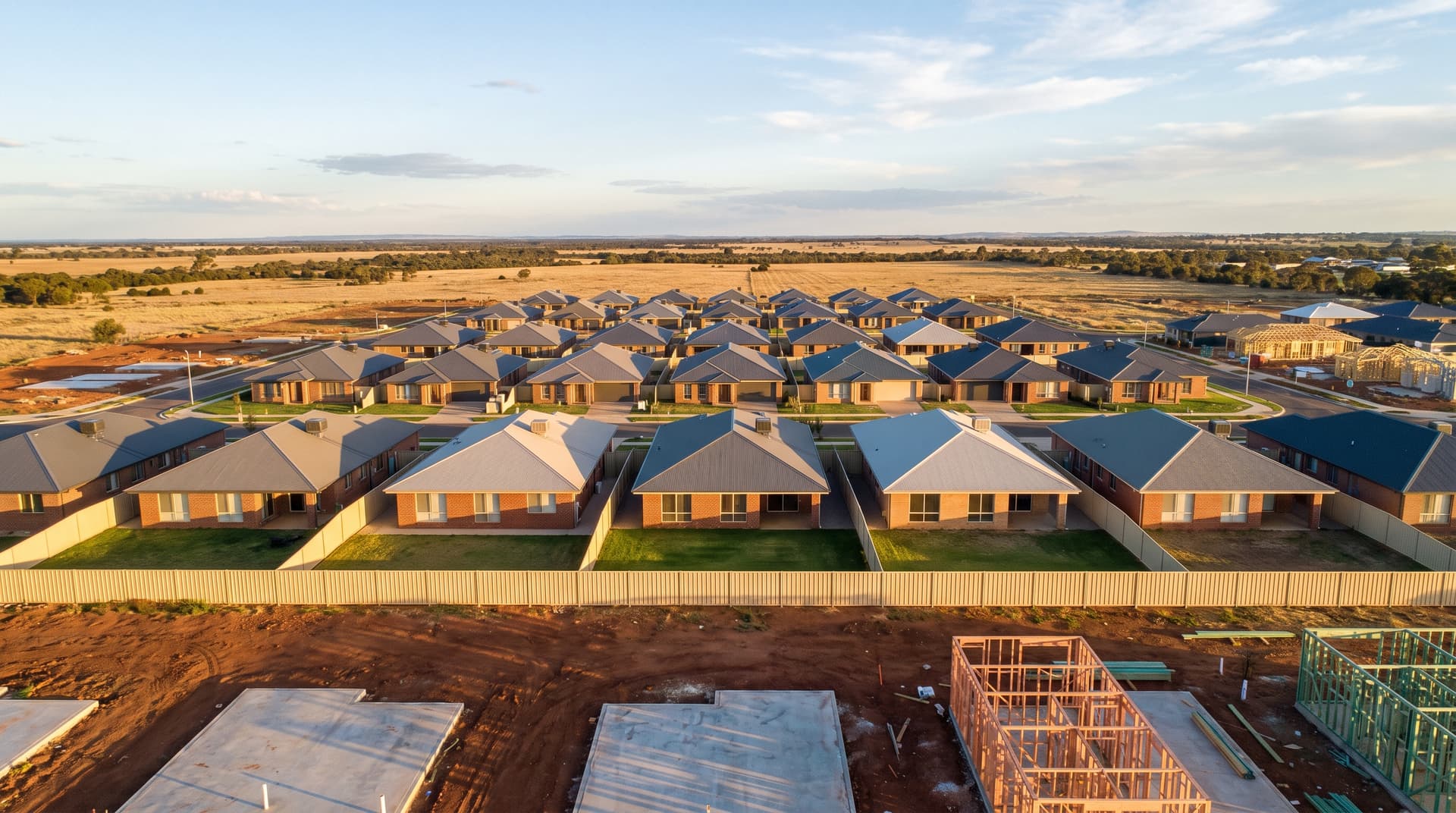
A house and land package investment property looks compelling on paper. You pay stamp duty only on the land. Maintenance is close to zero for the first few years. Tenants prefer new homes.
So why do so many experienced investors avoid them?
Because the metric that actually compounds wealth over a 10- to 20-year hold is land value growth. And with a house and land package, most of the value lies in the building component, not the land. Buildings depreciate. Land appreciates. When the depreciating asset dominates your balance sheet, the maths works against you over time.
This article breaks down the genuine advantages, the structural problems, and who a house and land package actually suits as an investment.
The Carrying Cost During Construction
One thing that catches new investors off guard: when building an investment property, you do not receive any income while it is in the planning stages or under construction, but you will be paying interest on any money you have borrowed by that point. That gap between outlays and income needs to be factored into your cash flow modelling before you commit.
The Genuine Advantages
Stamp duty on land only. Because the house does not yet exist at the time of the land purchase, you typically only pay stamp duty on the land component, which could mean saving thousands of dollars.
Low maintenance early on. With new property, there is none of that dreaded maintenance, at least for the first few years. No ageing hot water system. No cracked tiles. No surprises at the first inspection.
Tenants prefer new homes. Tenants typically love brand-new property with up-to-date features and modern floor plans. For investors, finding a tenant can be easier and rental returns can be stronger, depending on the overall supply in the area.
Customisation. When building a home you can often tailor certain elements to suit your specific needs or to maximise the investment potential. Floor plan choices and fixture selections can be made with tenants and future resale in mind rather than inheriting the previous owner's taste.
The Structural Problems Investors Overlook
Developer margin baked into the price
When you buy any brand-new property, factored into the price is the developer's profit margin and a proportion of the high marketing costs that come with selling this type of property. These hidden costs could be the equivalent of a few years of capital growth, putting you behind the eight ball from day one. An established property purchased at market value does not carry this premium.
Peripheral locations with limited growth drivers
The majority of house and land packages are located on the outskirts of the city, in areas often with abundant supply of land, weaker economic drivers and a lack of infrastructure. Capital growth is therefore often harder to come by.
The land-to-value ratio problem
This is the core issue. Logic dictates that when investing you should seek out a property with a high proportion of land value, as this is what will drive capital growth. With new property, however, most of the value lies in the building component and not the land, which will hamper capital growth as the building depreciates.
Compare that with an established property in a suburb where the land represents the majority of the total value. The appreciating component dominates.
No renovation upside
Smart investors know that adding value to a property through renovations is a key strategy for accelerating the wealth-creation process. This option is rarely available with new property. You cannot renovate something that was just built. That removes one of the most effective tools investors use to manufacture equity.
Risks Specific to Off-the-Plan Buying
A house and land package investment property is, by nature, an off-the-plan purchase. The property does not exist yet. That introduces risks you would not face with an established home.
When buying off the plan, you really do not know whether the quality of the finishes will meet your expectations, or what the surrounding facilities and other homes will be like. There is also the uncertainty that the final bank valuation will not stack up. Also, you will not know how many other similar rental properties have been sold to investors in the area.
That last point matters. If a large share of a new estate is investor-owned, you are competing with near-identical properties for a limited tenant pool. That compresses yields and increases vacancy risk.
Building can be a nightmare at the best of times, with construction delays a fairly common occurrence. The biggest surprise for many first-time builders is the amount of extra money that needs to be spent to get the property ready.
And throughout the build, you are paying interest on borrowed funds without receiving any rental income. Every delay extends that carrying cost with zero return.
House and Land vs Established Property
| Factor | House and land package | Established property |
|---|---|---|
| Stamp duty | On land only | On full purchase price |
| Maintenance (early years) | Minimal | Variable, budget required |
| Land-to-value ratio | Low (building dominates) | Higher in proven suburbs |
| Capital growth potential | Limited by location and ratio | Stronger in land-rich areas |
| Renovation potential | None | Significant |
| Developer premium in price | Yes | No (market-priced) |
| Rental demand | Strong initially | Depends on property and area |
A 30-year-old property on a good-sized block in the middle of suburbia might not look too glamorous when compared to a brand-new property, but chances are it will make a far better investment over the long term.
The honest framing is not "are house and land packages a good investment?" It is: good compared to what, and for whom? If you are comparing a house and land package on the urban fringe with an established property that has a high land-to-value ratio in a suburb with proven demand, the established property typically wins on capital growth.
Who Does a House and Land Package Actually Suit?
A house and land package investment property can work for investors whose primary goal is cash flow and tax minimisation in the short to medium term. The stamp duty savings and low early maintenance costs make new builds attractive for after-tax cash flow.
But if your primary goal is long-term capital growth, the structural disadvantages (peripheral location, low land content, developer premium, no renovation upside) are difficult to overcome. While investing in new property can seem appealing, it often proves unsatisfying over the long term due to weaker capital growth. If you are looking at a long-term investment opportunity, more often than not, your best option will be a second-hand property.
For investors weighing these trade-offs, our guides on negative gearing changes and depreciation schedules cover the tax side in detail.
What to Check Before Signing
If you do proceed with a house and land package, these are the factors that matter:
Land-to-total-value ratio. Calculate what percentage of the total package price is land. A low ratio means most of your money is in a depreciating asset.
Vacancy rates and competing supply. Check how many other investor-owned properties exist in the estate or are under construction. High investor concentration drives up vacancy and pushes rents down.
Builder track record. Research the builder's history with completions, defects, and timelines. Construction delays are common enough that due diligence here is not optional.
Inclusions vs extras. Understand what the base build price covers. The amount of extra money that needs to be spent to get the property ready surprises many first-time builders.
Market value vs developer price. Compare the total package price with recent sales of comparable finished homes in the same area. If the package price is materially higher, you are paying the developer premium.
For a broader look at financing an investment purchase, our guides on investment property deposits and investment property loans cover the lending side.
FAQ
Is a house and land package a good investment?
It depends on your goals. House and land packages offer stamp duty savings on the land component, low maintenance, and strong tenant appeal. But most of the purchase price sits in the building (which depreciates), not the land (which grows). For long-term capital growth, established properties with higher land content in proven suburbs typically outperform.
Do you pay stamp duty on a house and land package?
You typically pay stamp duty only on the land component, not the building. Because the house does not exist at the time of the land purchase, the building contract is excluded from the stamp duty calculation. This can save thousands compared to buying an established property at the same total price.
What are the risks of buying a house and land package as an investment?
Key risks include construction delays, paying interest during the build with no rental income, final bank valuations falling short, uncertainty over finish quality, and competing with other investors in the same estate for tenants. The developer's profit margin embedded in the price can also mean you are behind on capital growth from day one.
Is it better to buy an established property or a house and land package?
For long-term wealth building, an established property on a good-sized block in a suburb with strong demand drivers is generally the better investment. It carries a higher land-to-value ratio, no developer premium, and offers renovation potential. House and land packages suit investors who prioritise short-term cash flow and tax minimisation.