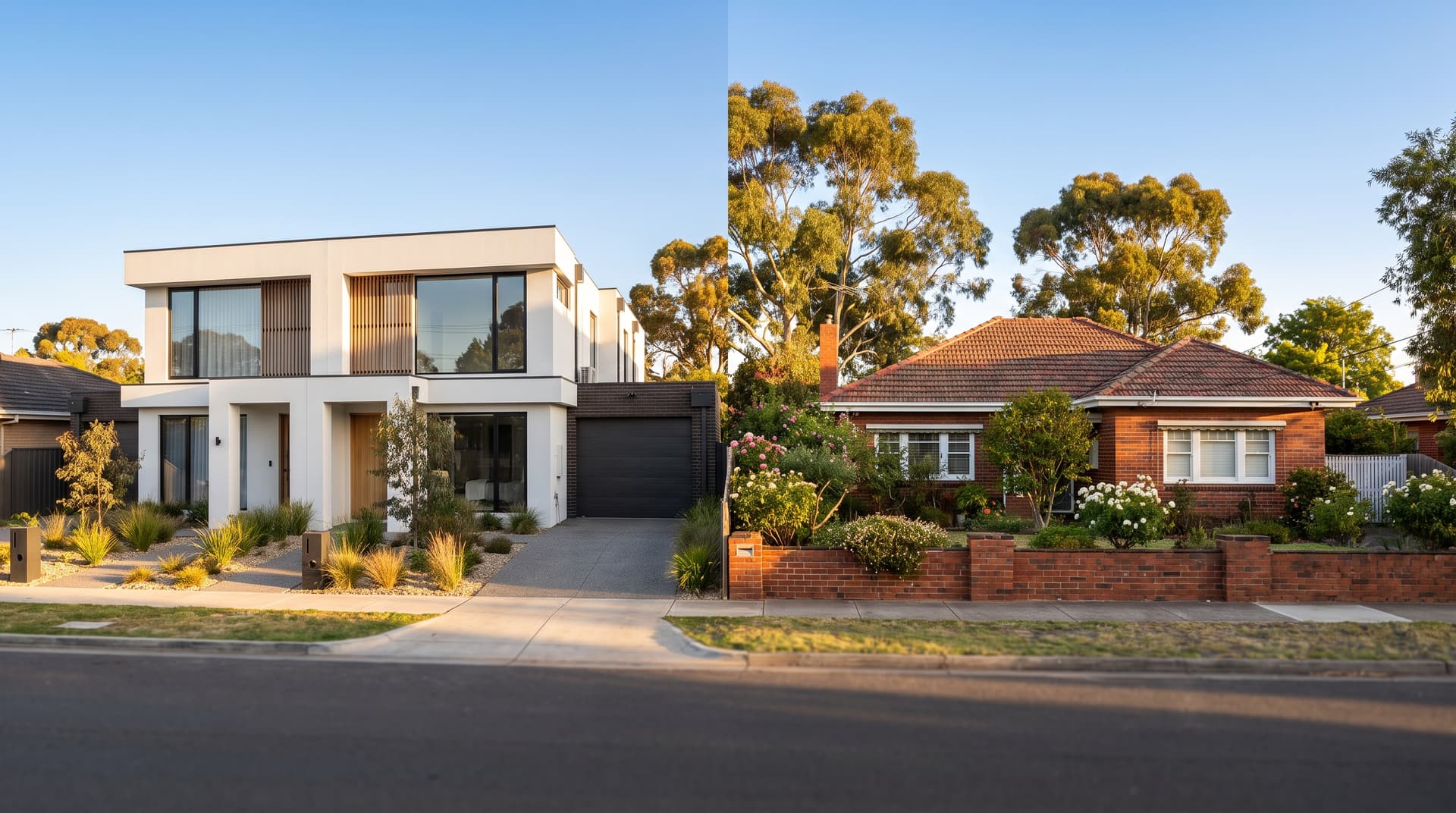
Most comparisons of new build vs established investment property in Australia were written before the law changed. They weigh depreciation against capital growth as though the tax rules are the same for both. They are not. Not anymore.
The Treasury Laws Amendment (Tax Reform No. 1) Act 2026 created a binary. From 1 July 2027, negative gearing for residential property is limited to new builds. The 50% CGT discount for individuals, trusts and partnerships is replaced by cost base indexation with a 30% minimum tax rate on capital gains. Both measures are now law.
That means the question is no longer “depreciation vs capital growth.” It is: do you want full tax relief now, or more wealth in 10 years? The answer depends on your income, your existing portfolio, and which side of a legislative line your next purchase falls on.
What the 2026 law changed
Negative gearing has not been abolished. It has been restricted for residential property. Commercial property and other asset classes remain subject to the existing arrangements.
For residential investors, the key changes from 1 July 2027 are:
- New builds retain both negative gearing (losses deductible against salary and other income) and the existing 50% CGT discount.
- Established properties purchased after 7:30pm AEST on 12 May 2026 have rental losses quarantined to residential rental income or capital gains from rental properties. Losses cannot be offset against salary. Excess losses carry forward to future years.
Properties held or under contract at the 7:30pm cutoff on budget night are grandfathered. The old rules apply to them indefinitely. For the full breakdown of the reform, see our negative gearing changes guide.
Grandfathered investors have a structural advantage
If you already owned investment property at the cutoff, the new rules work differently for you than for someone entering the market now.
As older properties become positively geared (mortgages reduce, rents rise), landlords with grandfathered properties can use profits from their old portfolio to immediately absorb quarantined losses from newly acquired established properties. A new investor buying their first established property has no such offset.
There is also a potential path for owner-occupiers. Because the legislation only required a property to be owned at the cutoff, not already rented, a former home could later qualify for old-style negative gearing when converted to a rental. Someone who owned their home on 12 May 2026, buys a new home in 2028, and rents out the original could technically claim under the old arrangements.
What qualifies as a “new build” under the law
The definition matters more than it used to, because it determines your entire tax treatment. Based on current guidance, eligible new builds include:
- A newly constructed apartment bought off-the-plan
- A duplex from a knock-down rebuild that replaces a single house (net increase in dwelling count)
- Any residential construction on previously vacant land
- A newly built property occupied for less than 12 months before first sale
Properties that do not qualify:
- An established property extended to add bedrooms
- A knock-down rebuild replacing one house with one house (no net increase)
- A granny flat built on a non-qualifying established property
- A newly built property occupied for more than 12 months before sale to an investor
The net-dwelling test is the one that catches people. Demolishing a house and building a single replacement house on the same block does not produce a new build for tax purposes.
Tax comparison: new build vs established after 2026
| New build | Established (post-cutoff) | |
|---|---|---|
| Negative gearing | Full: losses deductible against salary | Quarantined: losses offset rental income or rental capital gains only |
| CGT discount | 50% discount retained | Replaced by cost base indexation, 30% minimum rate |
| Division 43 (capital works) | 2.5% of construction cost p.a. for 40 years | Available if built post-1987 (remaining term) |
| Division 40 (plant & equipment) | Full claim on all fittings | Only items you personally install as new (2017 law removed second-hand claims) |
| Typical first-year depreciation | $10,000 to $18,000 (on $500K to $700K builds) | $4,000 to $8,000 (properties 10 to 20 years old) |
| Interest-only loan strategy | Still effective for maximising deductions | No longer effective for established purchases after the cutoff |
| Loss carry-forward | N/A (losses used immediately) | Excess losses carry forward indefinitely |
At the 37% marginal tax bracket, first-year depreciation of $10,000 to $18,000 on a new build translates to $3,700 to $6,660 in tax savings without any cash outlay. That is a real, immediate benefit.
But tax savings are not the whole picture.
The capital growth gap tax benefits do not solve
New builds have historically delivered 3 to 5% annual capital growth compared to 6 to 8% for established properties in proven suburbs. The reasons are structural: fringe locations, building depreciation reducing property value over time, and oversupply in new developments where multiple builders release stock simultaneously.
Over 10 years, that gap compounds into a wealth difference that dwarfs the depreciation advantage:
- A $700,000 new build at 4% annual growth reaches $1.04 million (+$340K)
- A $700,000 established property at 7% annual growth reaches $1.38 million (+$680K)
That is $340,000 more wealth from the established property despite identical starting prices. The additional depreciation benefits from a new build, even at their most generous, amount to roughly $25,000 over that period. The growth gap is an order of magnitude larger.
This does not mean every new build underperforms. Properties in genuinely supply-constrained areas with infrastructure spending can exceed those averages. But the structural tendency is real, and it is driven by land content. Land appreciates. Buildings depreciate. Established properties in inner and middle-ring suburbs tend to have higher land-to-value ratios.
The real costs of buying new, and the case for established
New build costs beyond the sticker price. House and land packages typically cost 15 to 25% more than the advertised base price once essential exclusions are added: landscaping, driveway, fencing, blinds, air conditioning, flooring, and council connection fees. A $450,000 package commonly lands at $520,000 to $560,000 all in.
Then there is the construction timeline. New build investors typically carry 12 to 18 months of interest costs with no rental income across land purchase and build phases. New builds also offer virtually no renovation value-add. Everything is already new. Warranties void structural changes in the first 6 to 7 years. Estate covenants typically prevent subdivision.
Where established properties have the edge. Established properties generate rental income from settlement day. Purchasing with existing tenants produces immediate cash flow to offset mortgage costs.
Renovation is where established properties can create equity that new builds cannot. Strategic renovations return 1.5 to 3 times the cost spent. A $40,000 cosmetic renovation (kitchen, bathroom, paint) can add $60,000 to $120,000 in value. Lenders generally perceive established properties as lower-risk investments, which can make financing easier to obtain.
On the other side, new builds can command higher rents because modern amenities and design attract tenants willing to pay a premium over comparable older properties.
Quarantined losses and what they do to the market
The quarantining of losses on established properties creates a hold incentive. Investors who buy established after the cutoff will wait for a capital gain large enough to absorb their trapped deductions before selling. If investors delay selling for tax reasons, the reforms may reduce the supply of established homes available for sale, placing upward pressure on prices.
There are early signs Australia's housing market is beginning to cool following the reforms. But the long-term impact on housing affordability remains uncertain.
The reforms also introduce a dual compliance system. Investors must track each property's purchase date, calculate losses separately for established and new build holdings, and carry forward excess losses from established properties with ongoing record-keeping. Mixed portfolios get more complex to manage.
Who should buy new, and who should not
A new build suits you if:
- You are in the 37 to 47% tax bracket and need tax relief against your salary now
- You do not already own grandfathered properties that could offset quarantined losses
- The location has genuine infrastructure-driven demand, not just developer marketing
- You prefer minimal maintenance and are comfortable with lower capital growth in exchange for higher depreciation
- You understand the true all-in cost (base price plus 15 to 25%) and the 12 to 18 month income gap during construction
An established property suits you if:
- You prioritise capital growth over current-year tax savings
- You already own grandfathered properties whose profits can absorb quarantined losses from new established purchases
- You want renovation upside (1.5 to 3x return on spend)
- You need immediate rental income from settlement
- You are building long-term wealth and can accept that losses are quarantined rather than deductible against salary
One important exemption: properties in widely held trusts and superannuation funds are exempt from the negative gearing changes, as are build-to-rent developments. If you are investing through an SMSF, the new vs established distinction does not affect your negative gearing treatment.
The old comparison, new build depreciation vs established capital growth, was always a trade-off. The 2026 law turned it into two separate tax regimes. Run the numbers for your specific situation, factoring in your marginal rate, existing portfolio, and timeline, before defaulting to either side.
For a deeper look at how the negative gearing changes affect your existing or planned portfolio, or to explore whether a coached research approach fits your next purchase better than going it alone, those guides break each topic down further.
FAQ
Is negative gearing still available for established investment properties?
Only for properties held or under contract at 7:30pm AEST on 12 May 2026. Established properties purchased after that date have rental losses quarantined to residential rental income or rental capital gains from 1 July 2027.
Do new builds still get the 50% CGT discount?
Yes. Eligible new builds retain both full negative gearing and the 50% CGT discount under the new law.
What counts as a new build for negative gearing purposes?
Off-the-plan apartments, construction on vacant land, knock-down rebuilds that add a net dwelling, and newly built properties occupied less than 12 months before first sale. A like-for-like knock-down rebuild (one house replacing one house) does not qualify.
Can I still claim depreciation on an established investment property?
Capital works (Division 43) remain available if the property was built after 1987. But plant and equipment (Division 40) can only be claimed on items you personally install as new, following 2017 legislation changes.
Are SMSF property investments affected by the negative gearing changes?
No. Properties in superannuation funds and widely held trusts are exempt from the negative gearing restrictions.