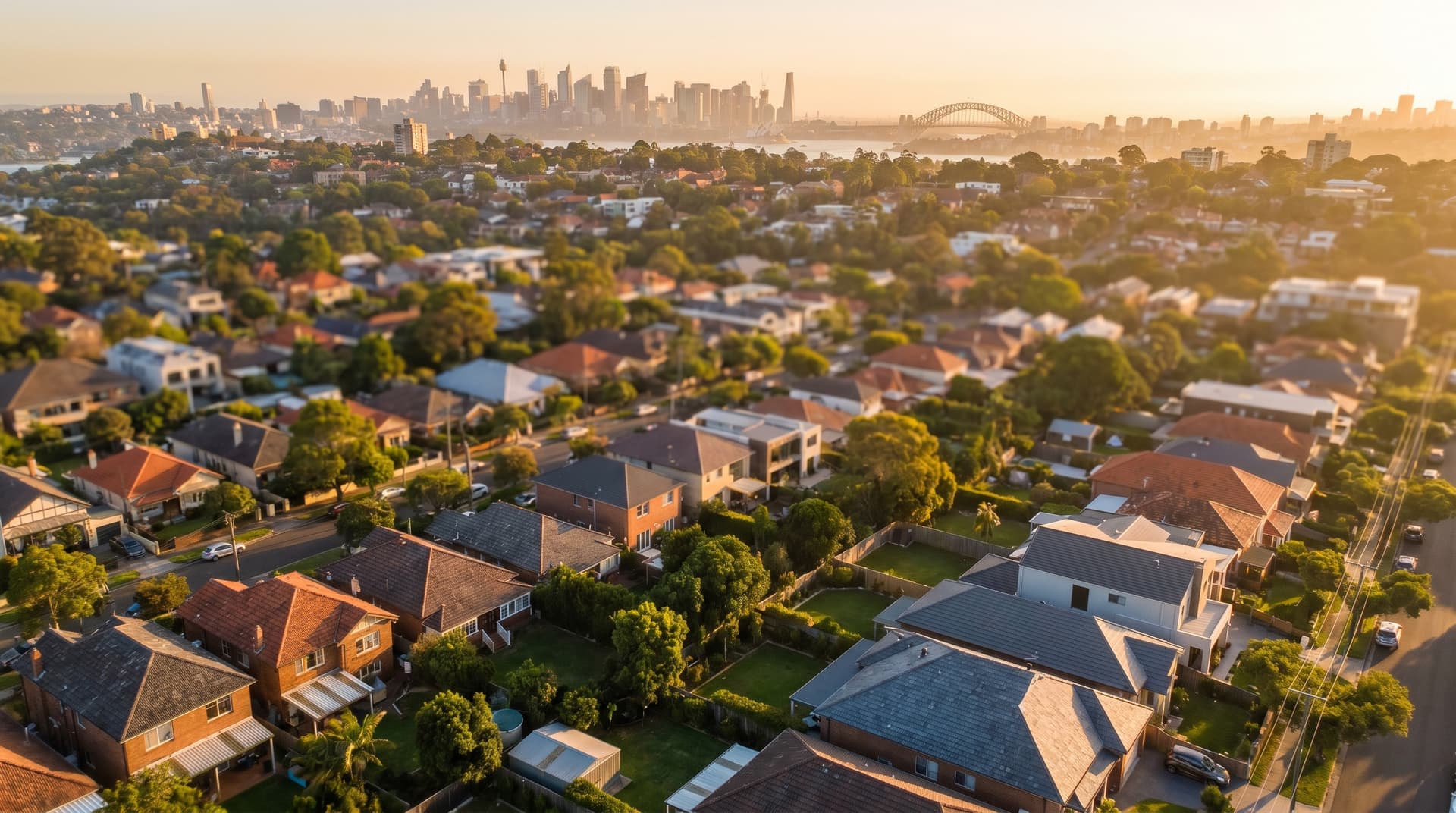
You invest in Sydney because it is the largest, most liquid property market in Australia. But “Sydney” is not one market. It is dozens of micro-markets, each with different price points, rental yields, growth trajectories and risk profiles.
This guide breaks down Sydney's investment landscape using current data: where prices sit today, what rents are doing, which corridors are attracting infrastructure spending, and how to use all of that to narrow your search to suburbs that actually match your strategy.
Where Sydney Prices Sit Right Now
According to the Australian Bureau of Statistics, the mean price of residential dwellings in NSW was $1,301,100 in the December quarter 2025. That is the highest of any state or territory in the country, ahead of Queensland at $1,066,000 and Western Australia at $1,014,200. The national mean sits at $1,074,700.
The total value of residential dwellings in NSW rose 1.7% over the December quarter 2025, contributing to a national total of $12,307.2 billion, up $384.8 billion from the September quarter.
The Cotality Daily Home Value Index (formerly CoreLogic) as of 30 April 2026 shows Sydney's annual growth at 4.2% across all dwellings. Houses grew 4.4% year-on-year, while units grew 3.4%. Monthly movement was negative at −0.6% for April 2026, indicating a short-term softening even as annual gains remain positive.
For investors, the takeaway is straightforward: Sydney still delivers capital growth, but the pace has slowed. The days of double-digit annual gains are behind us for now, and entry prices remain the highest in the country.
What Rents Are Doing
Sydney rents have plateaued at record levels. According to Domain's Rental Report for March 2026, the median weekly house rent in Sydney is $800, with 0% quarterly change. The median weekly unit rent is $750, also flat for the quarter. This marks the first time in five years that Sydney unit rents have remained flat across two consecutive quarters.
SQM Research's Weekly Rents Index (week ending 20 May 2026) shows Sydney's combined weekly asking rent at $917.81, with all houses at $1,153.99 and all units at $756.55. Over 12 months, house asking rents grew 7.5% and unit asking rents grew 6.7%.
The gap between the Domain settled-rent figure ($800 for houses) and the SQM asking-rent figure ($1,153.99 for houses) reflects the difference between what tenants are currently paying on existing leases versus what landlords are listing new properties at. The settled figure tells you what cash flow looks like today. The asking figure signals where rents are headed for new leases.
Domain's report also flags that Sydney's vacancy rate tightened to a record low of 0.8% in March 2026. Despite this, rents are holding flat rather than accelerating — affordability, not demand, is the binding constraint. Renters are reaching ceiling prices in markets where rents have already risen sharply.
If you are weighing up the numbers on a specific property, our rental yield calculator guide walks through the formulas step by step.
Yield vs Growth: The Sydney Trade-Off
Sydney has historically offered lower gross rental yields than other capital cities, offset by stronger long-term capital growth. That trade-off still holds.
With a mean dwelling price of $1,301,100 (ABS, December 2025) and a combined median weekly rent of roughly $800 (Domain, March 2026), a simplified gross yield calculation lands at approximately 3.2%. That is well below what you would find in Adelaide, Perth or Brisbane, where lower entry prices and strong rent growth push gross yields higher.
But yield is only half the equation. Sydney's Cotality index value of 4.2% annual growth (April 2026) means total return (yield plus capital growth) still competes with higher-yielding cities, particularly when you factor in the lower risk profile of Australia's most established market.
For investors focused primarily on cash flow, Sydney requires more targeted suburb selection. You need to look at areas where entry prices are lower relative to rents — which generally means moving further from the CBD and eastern suburbs.
Sydney's Growth Corridors: Where the Infrastructure Is Going
Infrastructure drives property values. In Sydney right now, four major transport corridors are reshaping the investment map.
The M1 Metro Line (Operational)
Sydney Metro is Australia's biggest public transport project. The M1 Line opened on 26 May 2019 with 13 stations across the North West, operating every four minutes in peak periods on Australia's first driverless railway.
The M1 was extended on 19 August 2024, with 15.5 kilometres of new metro rail running from Chatswood under Sydney Harbour, through the CBD, to Sydenham — connecting the north-west directly to the city centre for the first time via metro.
The suburbs around the original North West stations (Tallawong through to Chatswood) have already priced in much of the metro benefit. The newer southern stations present a different picture, particularly as the line extends further.
Metro Southwest (Under Construction)
The T3 Bankstown Line is being converted to metro standards between Sydenham and Bankstown. This connects Bankstown, one of Sydney's most established multicultural hubs, directly into the metro network.
The NSW Government's planning portal lists Bankstown as a priority growth area, meaning rezoning, higher-density development approvals and infrastructure investment are all on the table.
Metro West (Under Construction)
This is the corridor most investors should be watching. Metro West is a 24-kilometre line that will double rail capacity between Greater Parramatta and the Sydney CBD. Confirmed stations include Westmead, Parramatta, Sydney Olympic Park, North Strathfield, Burwood North, Five Dock, The Bays, Pyrmont and Hunter Street in the CBD.
The NSW Government has designated Greater Parramatta and Olympic Peninsula as a priority growth area, describing it as “fast emerging as the centre of Sydney and set to experience significant growth and change over the next 20 years.” Suburbs along the corridor — Burwood, Strathfield, Homebush, Camellia–Rosehill and Carter Street — are all listed as priority precincts.
Western Sydney Airport Metro (Under Construction)
The newest corridor connects to Western Sydney International (Nancy-Bird Walton) Airport and Bradfield City Centre. Construction started in late 2020, with the metro line set to open alongside the airport.
Priority growth areas feeding into this corridor include the Western Sydney Aerotropolis, Greater Penrith to Eastern Creek, Greater Macarthur, Leppington and the South West Growth Area. This is the most speculative play in Sydney: prices are lower, timelines are longer, and the payoff depends on the airport precinct delivering on its promise. But the infrastructure commitment is real and entry prices are significantly below Sydney's metro-wide mean.
How to Evaluate a Sydney Suburb
With dozens of micro-markets across the city, you need a systematic way to narrow your shortlist. Here is what to look at for each suburb you consider:
- Median price relative to your budget. Sydney's mean dwelling price is $1,301,100 (ABS, December 2025), but individual suburbs range from under $600,000 for units in the outer west to over $3 million for houses on the North Shore. Know where you sit and filter accordingly.
- Rental yield. Calculate the gross yield using annual rent divided by purchase price. Our rental yield guide covers the full formula. In Sydney's current market, anything above 4% gross is worth a closer look.
- Vacancy rate. Sydney's metro-wide vacancy rate is 0.8% (Domain, March 2026), but individual suburbs vary. Under 2% signals strong tenant demand; higher vacancy means oversupply or limited tenant appeal.
- Infrastructure pipeline. Cross-reference your target suburb against the NSW Government's priority growth areas. Government investment in transport, schools and rezoning is a tailwind for capital growth.
- Proposed planning changes. Rezoning for higher density can increase land values but also introduces competition from new stock. Moneysmart recommends checking your local council's planning portal before committing.
The Tax Landscape Is Shifting
Be aware that the tax settings around property investment are changing. The 2026 Federal Budget announced changes to both negative gearing and capital gains tax, subject to final legislation. These changes could materially affect after-tax returns on investment property.
Until the final legislation is passed, the exact impact remains uncertain. It is worth stress-testing your numbers under different scenarios. Our guide to investment property tax deductions covers the current deduction framework and will be updated as the new rules are finalised.
Putting It Together: A Framework for Sydney Investors
Sydney rewards investors who do the homework. The broad numbers — mean price of $1,301,100, median rents of $800 for houses and $750 for units, vacancy at 0.8% — tell you the market is expensive, tightly held, and generating modest yield.
But drill down into corridors and you find opportunity. Metro West stations like Westmead, Parramatta and Sydney Olympic Park sit at the intersection of government infrastructure investment, priority growth area designation, and relative affordability compared to the eastern suburbs. The Western Sydney Airport corridor offers even lower entry points for investors with a longer time horizon.
The investors who do well in Sydney pick a strategy (yield, growth, or a blend), filter suburbs against real data, and resist the urge to overpay for premium postcodes the market has already priced to perfection.
If you are still deciding whether to buy your own home first or invest while renting, our rentvesting guide breaks down that decision. And if you are looking for help narrowing down suburbs without paying a full buyer's agent retainer, check out how PropSpotter works as an alternative approach.