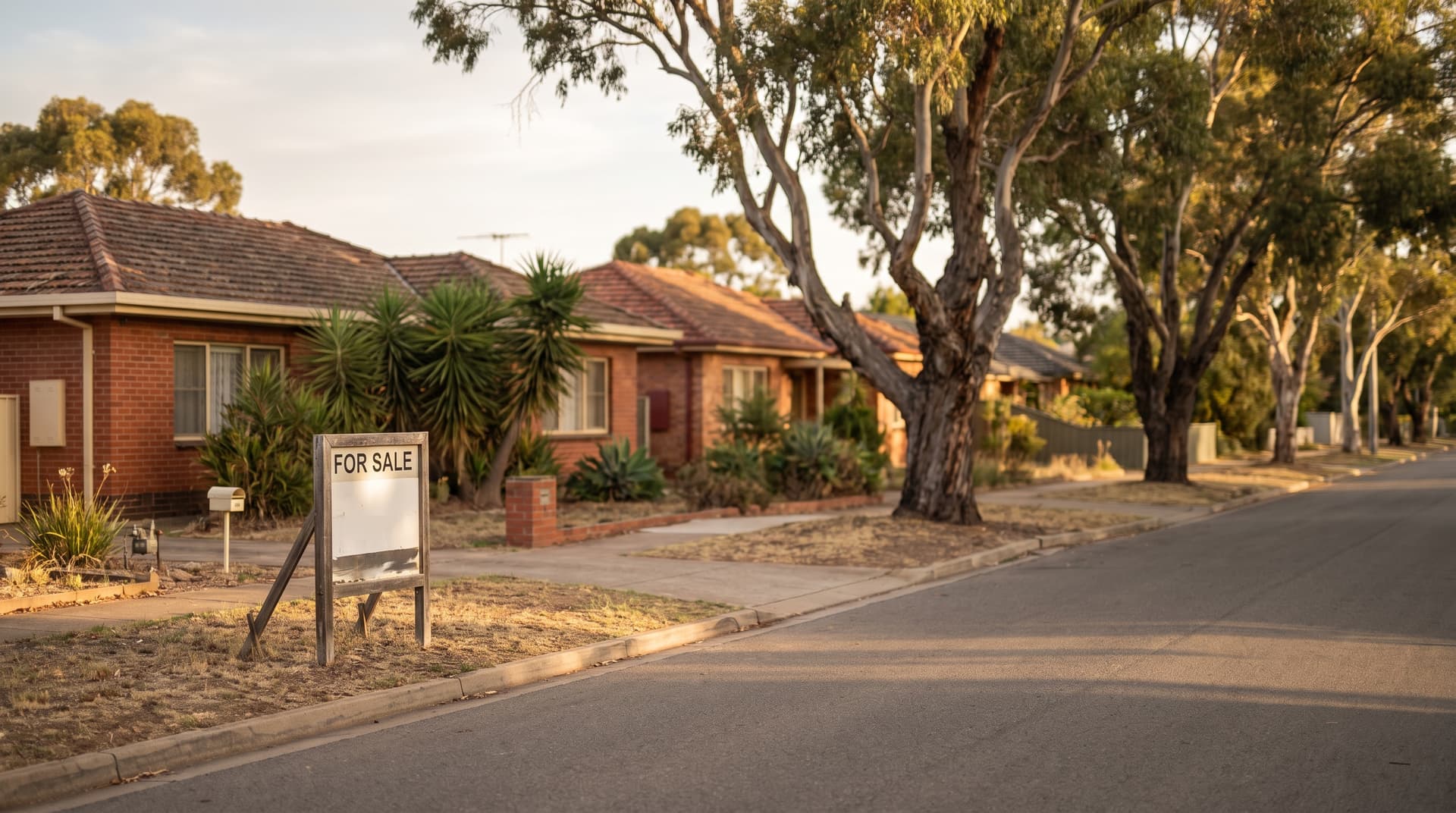
National capital city house prices fell 1.4% in the June 2026 quarter, the first time prices have fallen in three years. Unit prices dropped 1.2% across all capitals except Darwin. The boom is over.
And investors are running. Mortgage applications from investors are down 35%, the steepest retreat of any buyer segment. Overall home loan applications have declined by about 23% since the start of February. The herd is spooked.
That retreat is the signal worth paying attention to. Not because the downturn is good news. It is not. But because the mass withdrawal of competing buyers creates conditions that do not exist in a rising market: lower prices, fewer offers, and more room to negotiate.
The 2026 downturn in numbers
The Domain report confirmed a decisive shift in market conditions. Higher interest rates, affordability constraints, waning buyer confidence, rising listings, and slower selling times have converged.
The key figures:
| Metric | Change |
|---|---|
| National house prices (June quarter) | -1.4% |
| National unit prices (June quarter) | -1.2% |
| Annual growth | Positive, but slowest in 9 months |
| Home loan applications (since start of Feb) | -23% |
| Investor mortgage applications | -35% |
| First home buyer applications | -19% |
| Owner-occupier upgrader applications | -15% |
Sydney, Melbourne, and Canberra are leading the declines. But Adelaide, Brisbane, Perth, and Hobart house prices remain at record highs. This is a two-speed market, not a uniform collapse.
One economist expects this downturn to be larger than the prior 7.5% national downturn. Separately, the analysis points to what has been described as a “perfect storm” of conditions: low affordability, low sentiment toward housing, a weakening economy with poor productivity growth, reduced incentives to invest in housing, relatively high interest rates, and high inflation that looks set to continue for some time.
But economists also agree on something else: this is unlikely to trigger a correction or crash. For context on the difference between a downturn and a crash, our housing market crash guide breaks down those scenarios in detail.
Why investors are retreating, and why that creates your opening
The 35% drop in investor mortgage applications is the sharpest pullback of any buyer segment. Owner-occupier upgraders are down 15%. First home buyers are down 19%. Investors have pulled back at more than double the rate of upgraders.
Domain’s Dr Powell noted that investors have become nervous and are shying away from the housing market, and that this may be having a ripple effect on first home buyers as well. First home buyers are taking a cautious approach, thinking that if they wait a little bit longer and prices pull back further, they may get more for their money.
This behavioural response from the crowd is precisely what creates opportunity for the buyer who acts. Fewer applications mean fewer competing offers on any given property. Longer selling times mean vendors are more flexible. The competitive dynamics that defined the boom (20 registered bidders, offers above asking on day one) have reversed.
To be clear: this is not a prediction that prices have bottomed. Nobody knows where the bottom is, and trying to time it perfectly is a fool’s errand. The point is that the conditions present right now (reduced competition, more negotiating power, longer days on market) only exist because other buyers have stepped away. By the time sentiment recovers, so will the competition.
What downturns have historically done in Australia
Australian housing downturns have historically been fairly short-lived. Recoveries have been driven by interest rate reductions and government stimulus, typically directed at first home buyers.
This pattern matters for two reasons.
First, if you buy during the downturn, you are positioning ahead of a recovery that rate cuts would accelerate. You do not need to predict when the RBA will move. You just need to be already holding when they do.
Second, the price declines during this downturn will not materially improve affordability. Interest rates remain elevated, and dwelling values rose so far and so fast over recent years that a modest pullback does not reset the playing field. Anyone waiting for a return to the affordability of 2019 is likely waiting for something that will not arrive. Our 2026 housing market correction analysis covers why the structural constraints on affordability persist even as headline prices soften.
How far could prices fall?
The expectation is that this downturn will exceed the previous 7.5% national decline. The combination of low affordability, weak sentiment, a weakening economy, reduced investment incentives, high rates, and high inflation suggests the conditions for further falls are in place.
But geography matters enormously.
Sydney and Melbourne are already recording quarterly declines. Canberra is following. Meanwhile, Adelaide, Brisbane, Perth, and Hobart house prices remain at record highs. Buying in a market that has already corrected is a different risk profile from buying in one that has not started to fall.
For investors focused on yield rather than purely capital growth, high rental yield suburbs in markets where rents remain strong offer a cash-flow buffer against further price softening.
The upgrading opportunity inside the downturn
One dynamic that gets overlooked in the downturn narrative: expensive properties are seeing larger value falls than cheaper ones. The gap between entry-level and mid-tier properties narrows during downturns.
If you already own a property and are thinking about upgrading to a better-located or higher-quality asset, the relative cost of that move is smaller now than it was six months ago. Your current property may be worth less, but the property you are buying has fallen by more. This applies to investors moving from a low-growth holding to a better-positioned one.
A practical checklist for buying during this downturn
Target markets where investors have retreated hardest. The 35% pullback is a national figure. Some submarkets will have seen steeper withdrawals. Those are the areas with the least buyer competition right now.
Separate the two-speed cities. Sydney and Melbourne are declining. Adelaide, Brisbane, Perth, and Hobart are at record highs. Your risk tolerance and strategy should dictate which side of that divide you buy on. A declining market offers entry below recent peaks. A record-high market may offer rental yield strength but less room for short-term capital growth.
Stress-test your holding costs. The conditions driving this downturn (high rates, high inflation, weak economy) mean you need to hold comfortably for several years. Know your cash flow position before you commit. Understand what you can and cannot claim through tax deductions on investment property.
Do not wait for the bottom. The conditions that make buying attractive during a downturn (fewer competitors, more negotiating room, flexible vendors) only exist while other buyers are absent. Once sentiment recovers, those conditions vanish before prices visibly move. You cannot have both maximum certainty and minimum competition.
Have your finance ready. Overall home loan applications are down 23%. Lenders are still writing loans. If you have equity in an existing property and your serviceability is solid, you can move faster than most of the market right now.
Get structured guidance. A downturn is the worst time to be guessing at suburbs. Independent property investment coaching can help you build a data-driven shortlist rather than buying on sentiment or panic.
FAQ
Is 2026 a good time to buy investment property in Australia?
The 2026 downturn has reduced buyer competition (investor applications down 35%) and prices have begun falling in several capitals. Whether it is a good time depends on your financial position, holding timeline, and ability to manage uncertainty. The reduced competition and lower prices create conditions that did not exist during the boom, but further falls are possible.
Will the Australian property market crash in 2026?
Economists do not expect the current downturn to trigger a crash. The decline reflects higher interest rates, affordability constraints, and weakening confidence, but the historical pattern of short-lived downturns makes a crash scenario unlikely.
Which Australian cities are seeing property prices fall in 2026?
Sydney, Melbourne, and Canberra are leading the house price declines. Adelaide, Brisbane, Perth, and Hobart house prices remain at record highs. Unit prices have fallen across all capitals except Darwin.
Should I wait for prices to drop further before buying?
Waiting for the bottom means competing with every other buyer who has the same idea. The practical advantage of buying during a downturn (less competition, more negotiating room) only exists while fear keeps other buyers away. Once confidence returns, competition returns before prices visibly recover.