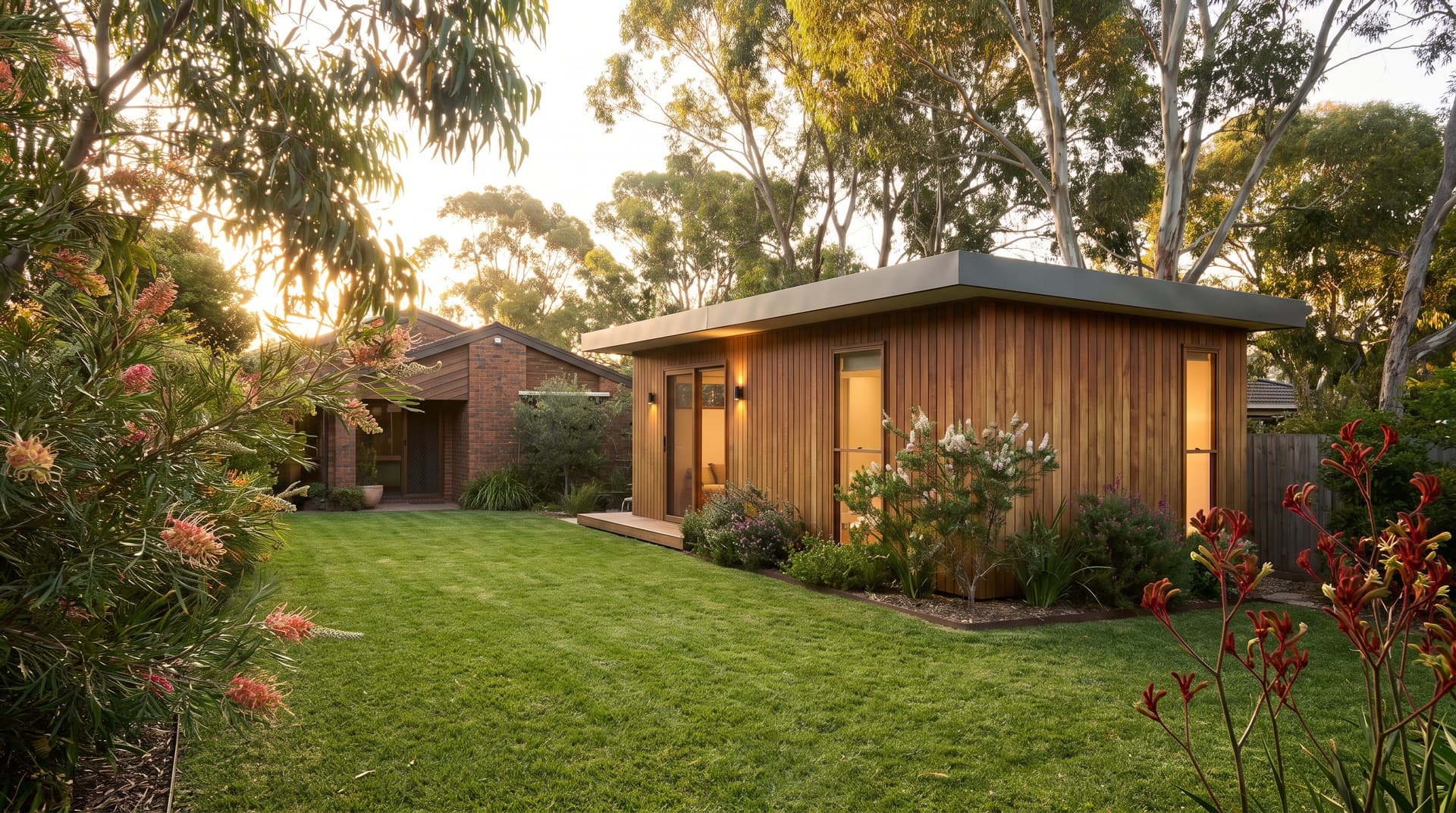
A granny flat is a cashflow instrument. It is not a capital growth vehicle. The investors who do well with them understand this distinction before they pour a slab.
That framing matters because the granny flat investment landscape shifted dramatically between 2022 and 2024. Four states changed their laws to allow homeowners to rent granny flats to anyone, not just family members. Searches for granny flats on realestate.com.au surged by over 50% in 2024. CoreLogic estimates more than 655,000 properties across Australia's three largest capitals are suitable for a granny flat build.
But demand and suitability are not the same as a sound investment decision. Whether a granny flat makes sense depends on what you are optimising for.
Yield and demand: why granny flats attract investor attention
The headline numbers are compelling. Granny flat rental yields often exceed 7%, with some reaching 12%, compared to the 3–5% typical for standard investment properties.
CoreLogic data reinforces the rental premium. Properties advertised with a granny flat attract 27% higher weekly rents than those without one. If you want to understand how that translates to your specific numbers, our rental yield calculator guide walks through the method.
Sydney alone has around 242,000 suitable properties, representing 17.6% of the metro region's housing stock. Melbourne has almost 230,000 potential sites (13.2% of stock), and Brisbane has almost 185,000 (23.3% of houses across the metro region). More than a third of these sites sit within two kilometres of a train or light rail station, which matters for tenant demand.
If you are looking at the Sydney market specifically, our Sydney property investment guide covers suburb-level dynamics worth understanding before choosing a build location.
What a granny flat costs to build and what it returns
Build costs vary widely depending on how much work you do yourself.
| Build type | Approximate cost |
|---|---|
| DIY flat pack | From $30,000 |
| Owner-builder permit (arrange trades yourself) | $120,000–$140,000 |
| Licensed builder, 60sqm two-bedroom | $180,000+ |
| Custom-built, high-spec | $200,000+ |
The average build cost sits around $120,000, roughly 25% of the median Australian house price. At the higher end, a 60-square-metre, two-bedroom granny flat built by a licensed builder generally costs above $180,000. An owner-builder permit can bring that down to $120,000–$140,000.
On the income side, a granny flat can attract $500 per week in some areas in the current undersupplied rental market. At $500/week, that is $26,000 per year. On a $160,000 build, the outlay is recouped in just over six years, before accounting for interest on borrowings or maintenance.
Compare that to a traditional investment property. Buying a standalone dwelling costs $600,000 or more, yields 3–5%, and the break-even timeline stretches to 15–20 years.
The capital growth caveat
This is where many granny flat investment articles stop. They present the yield, show the break-even timeline, and move on. But yield is only half the investment equation.
CoreLogic data reveals a telling asymmetry: properties with a granny flat attract 27% higher weekly rents but only 2.7% higher estimated sale prices. The rental premium is ten times the capital value premium. A granny flat generates income. It does not reliably generate equity.
Lloyd Edge, founder and director of Aus Property Professionals, puts it directly: lenders often do not value the property much higher, if at all, than the cost to build. You spend $180,000 on a build and the bank valuation might barely move.
There is also a resale consideration. Not everyone wants a tenant in their backyard, so when it comes time to sell, there will be fewer buyers. That can lessen demand and even the price buyers are prepared to offer.
If your strategy is focused on achieving higher cashflow and rental yield, then a granny flat strategy may be the right choice. If you are looking for long-term capital growth as the cornerstone of wealth creation, a granny flat will not guarantee that.
Tax benefits: depreciation, interest, and deductions
A granny flat that generates rental income is an income-producing asset. That opens up depreciation claims, interest deductions, and capital works allowances. Our investment property tax deductions guide covers the full range of what you can claim.
The depreciation numbers are material. According to estimates from Washington Brown quantity surveyors:
- A $100,000 granny flat produces a depreciation claim of $7,100 in its first year ($5,000 for plant and equipment, $2,100 for capital works). Over five years, claims amount to $22,900, almost a quarter of the construction cost.
- A $200,000 granny flat generates roughly $12,300 in first-year deductions ($7,900 plant and equipment, $4,400 capital works) and $38,500 over five years.
For high-income earners with a focus on tax reduction, a granny flat can provide additional depreciation, capital deductions, and interest expenses. You cannot claim depreciation on your owner-occupied property, but you can depreciate a granny flat if it is an income-producing asset.
Interest on borrowings used to fund the build is also deductible, which brings us to financing.
How to finance a granny flat build
The most common path is using equity from an existing property. Depending on the situation, homeowners can borrow up to 100% of build costs using equity from their owner-occupied home.
The rental income from the completed granny flat can then help boost or maintain servicing capacity with lenders, which may help with the next property acquisition. This is where a granny flat investment fits into a broader portfolio strategy: the cashflow it produces does not just sit in isolation. It can improve your ability to borrow for future purchases.
State-by-state: the 2022–2024 regulatory reforms
Before 2023, 60 to 70% of granny flats were built in NSW because other states restricted rentals to family members only. That changed rapidly.
Between September 2022 and January 2024, Queensland, South Australia, Western Australia, and Victoria all changed their laws to let homeowners rent granny flats to anyone.
Here is where each state sits now:
New South Wales has long supported granny flats, permitting them on lots over 450 square metres with a maximum dwelling size of 60 square metres.
Victoria introduced no-permit granny flat construction for dwellings under 60 square metres on blocks of at least 450 square metres.
Western Australia removed the requirement for planning approval for compliant granny flats up to 70 square metres in January 2024, and scrapped the previous minimum lot size requirement of 350 square metres entirely.
Queensland and South Australia both changed their laws between September 2022 and January 2024 to permit non-family rentals.
These reforms mean a granny flat investment is now viable in every mainland state, not just NSW.
Who should build a granny flat (and who should not)
CoreLogic's head of research, Tim Lawless, frames the opportunity clearly: building a granny flat can help manufacture new capital gains while generating rental income and meeting demand for more affordable housing.
But “can help” is doing work in that sentence. The 2.7% sale price premium versus 27% rental premium tells the real story. A granny flat investment works for some strategies and undermines others.
A granny flat makes sense if you are:
- A cashflow-focused investor holding a property long-term, where the rental yield matters more than the resale price
- A high-income earner seeking tax benefits through depreciation and interest deductions on a new income-producing asset
- An owner-occupier wanting to offset mortgage costs with rental income from a second dwelling
- Building a portfolio and need the extra rental income to improve borrowing serviceability for your next purchase
A granny flat is a poor fit if you are:
- Primarily seeking long-term capital growth in blue-chip markets, where the build cost may not translate to equivalent equity
- Planning to sell within a few years to owner-occupiers, where the granny flat may narrow your buyer pool
- Expecting the build to create instant equity, as lenders often do not value the property much higher than the cost to build
The distinction is simple. A granny flat turns a single-income property into a dual-income property. It does that well. It does not reliably turn a $600,000 property into a $780,000 property. Know which outcome you need before you commit to a build.
FAQ
How much does it cost to build a granny flat in Australia?
Costs range from about $30,000 for a DIY flat pack to over $200,000 for a custom-built dwelling. A licensed builder typically charges above $180,000 for a 60-square-metre, two-bedroom granny flat. An owner-builder permit can reduce costs to $120,000–$140,000. The national average sits around $120,000.
What rental yield can a granny flat achieve?
Granny flat rental yields often exceed 7%, with some reaching 12%. This compares to the 3–5% typical for standard investment properties. Properties with a granny flat attract 27% higher weekly rents than equivalent properties without one.
Can I build a granny flat without council approval?
It depends on your state and the size of the dwelling. In Victoria, no permit is needed for granny flats under 60 square metres on blocks of at least 450 square metres. In WA, compliant granny flats up to 70 square metres no longer require planning approval. NSW permits granny flats on lots over 450 square metres with a maximum size of 60 square metres. Check your state's current rules, as regulations changed significantly between 2022 and 2024.
Do granny flats add value to a property?
CoreLogic data shows properties with a granny flat have 2.7% higher estimated sale prices but 27% higher weekly rents. Lenders often do not value a property much higher after a granny flat is added. The primary value is in ongoing rental income, not capital gains at resale.