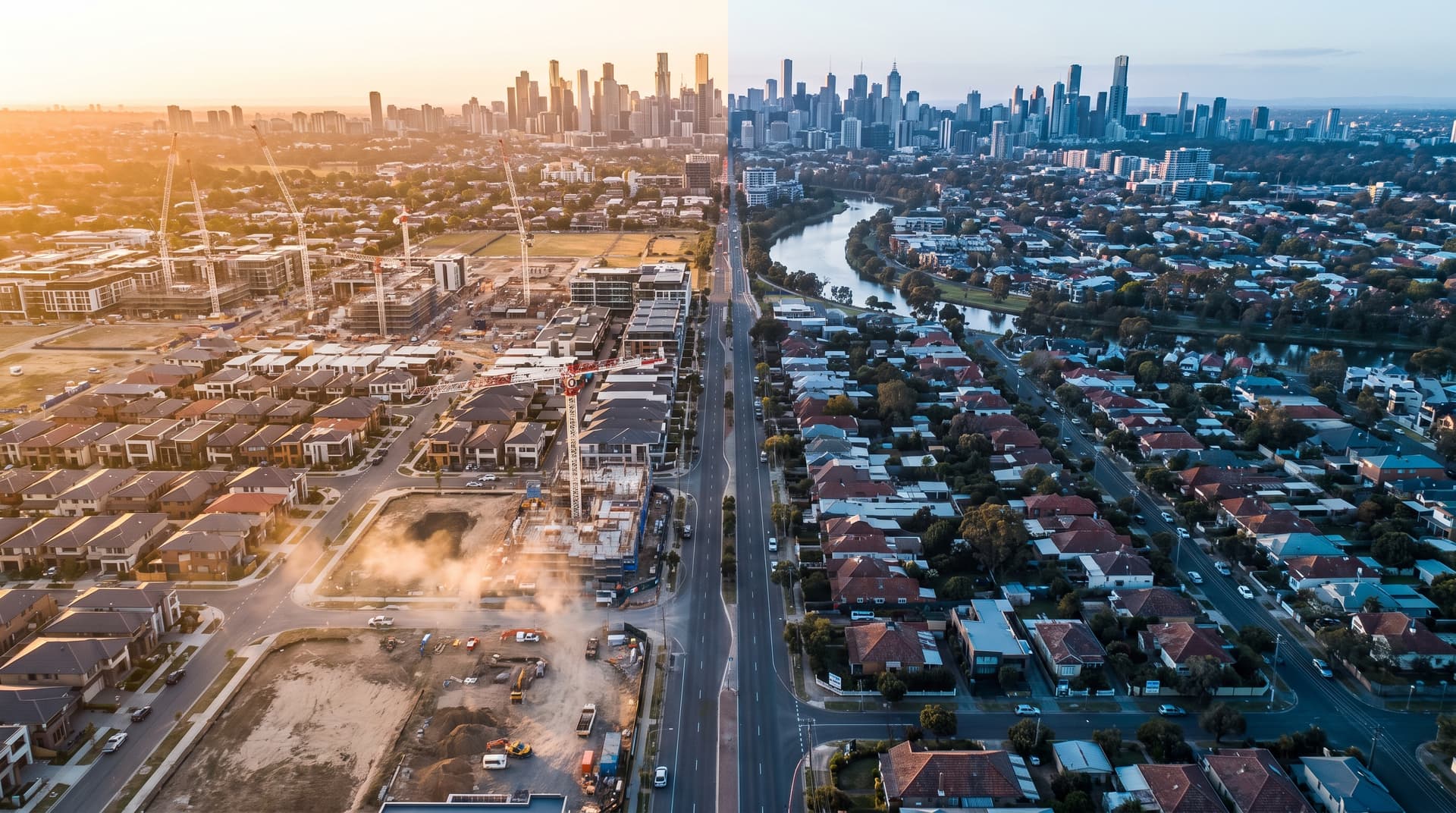
Perth added $22,500 to its median dwelling value in a single month. Sydney lost value over the same quarter. Same country, same interest rate, same economy. Two completely different markets.
That gap defines the two speed property market Australia is living through in 2026. The $12.5 trillion national housing market continues to grow in aggregate, but the national number is masking a widening divide between supply-constrained mid-sized capitals and the larger markets where vendor urgency is rising and buyers have options.
The common explanation is rates. That is part of it. The bigger driver is inventory, and the inventory gap between these two groups of cities is structural, not cyclical.
Perth sprints, Sydney flatlines: the numbers
In February 2026, Perth home values jumped 2.3% in a single month. Brisbane, Adelaide and Hobart each recorded rises above 1%.
Sydney and Melbourne moved in the opposite direction. Home values fell over the rolling quarter: Sydney -0.1%, Melbourne -0.4%. Both cities were flat month-on-month.
That is not a minor divergence. Perth is growing at an annualised rate above 25% while Sydney and Melbourne are treading water. CBA's forecasts for the full year reflect the same gap: Perth +15%, Brisbane +12%, Sydney +2%, Melbourne +1%.
Supply is doing most of the work
Interest rates apply equally across the country. The split comes from what is happening underneath: how many properties are available for sale in each market.
The gap is stark. In the four weeks to late February 2026, Perth listings were 48% below their five-year average. Brisbane sat 31% below. Adelaide was 23% below. Buyers in these cities are competing over a pool of stock that is roughly half, or less, of what was available a few years ago.
Sydney and Melbourne are a different story entirely. Sydney listings were only 1% below the five-year average, and Melbourne sat just 4.3% below.
It gets worse for sellers in the bigger capitals. Fresh listings flowing into Sydney were 9.7% above the five-year average; in Melbourne, almost 12% above. Vendors in those markets are motivated, possibly trying to beat a further softening in selling conditions.
When there are half as many properties for sale, prices rise. When stock levels normalise and new listings pile up, sellers lose leverage. That mechanism explains more of the two speed property market than any single RBA decision.
| Perth | Brisbane | Adelaide | Sydney | Melbourne | |
|---|---|---|---|---|---|
| Monthly growth (Feb 2026) | +2.3% | +1%+ | +1%+ | Flat | Flat |
| Rolling quarter | Rising | Rising | Rising | -0.1% | -0.4% |
| Listings vs 5-year avg | -48% | -31% | -23% | -1% | -4.3% |
| New listings vs 5-year avg | Low | Low | Low | +9.7% | +12% |
| CBA 2026 forecast | +15% | +12% | — | +2% | +1% |
How 2025 set the stage
The divergence did not appear overnight. Australia's housing market staged a turnaround in 2025, growing above its decade-average pace at roughly 8% for the year. Three RBA rate cuts, an expansion of the 5% Home Guarantee Deposit Scheme, and persistently low listing volumes drove the recovery and pushed the total market to $12 trillion.
But even that recovery was uneven. Darwin posted the strongest rise among capitals at 17.1%, followed by Brisbane and Perth. Lower-value markets delivered outsized gains: WA dominated, with Kalbarri increasing 40.2%, followed by Rangeway at 32.2% and Lockyer at 32.0%.
Investor capital followed the growth. The share of new mortgage lending to investors reached 38.3% in WA and 41.1% in QLD. That concentration of investor demand in two states further tightened supply in markets that were already short on stock.
The split inside the split
The two speed property market is not just a story about Perth versus Sydney. It is fractal. The same pattern plays out within individual cities.
In Sydney, lower-quartile house values rose 0.8% in February while upper-quartile house values fell 0.9%. The same trend, to varying degrees, appeared across each capital.
The mechanism is serviceability. With the average new mortgage loan approaching $700,000 and a 3% serviceability buffer in place, buyers are increasingly locked out of higher price points. That concentrates demand in lower-priced segments, which is why entry-level properties in Sydney are still rising even as the broader market softens.
Premium suburbs operate on a separate cycle entirely, less sensitive to borrowing costs and listing trends. Their performance often diverges from the broader market in both directions.
So the split runs three layers deep: between cities, between price tiers within cities, and between the premium segment and everything else. An investor buying a $500,000 house in Perth and an investor buying a $2 million apartment in Melbourne are not participating in the same market, even though both show up in the national statistics.
What the major banks forecast for 2026 and 2027
CBA and Westpac both project continued outperformance from mid-sized capitals, though they disagree on the magnitude.
CBA's numbers: Perth +15%, Brisbane +12%, Sydney +2%, Melbourne +1% for 2026. Westpac is more bullish on Melbourne, seeing more headroom from its relatively lower price base, and less bullish on Brisbane at +7%.
One point of agreement: no capital city is expected to see price falls over the next two years.
Melbourne's slower forecast reflects its structural headwinds. The city has relative affordability advantages, but higher rates of construction, softer local economic conditions, and Victoria's less investor-friendly tax settings are keeping a lid on any strong rebound.
The gap will compress over time. CBA expects Perth and Brisbane growth to fade to 4% annual growth by end of 2027 as higher interest rates take hold, housing construction picks up, population slows, and affordability constraints become more binding.
Three headwinds closing the gap
Several forces are working to slow the boom cities and bring the two speed property market closer to equilibrium.
The CGT discount reduction. The anticipated cut from 50% to around 25% is expected to subtract approximately 0.9 percentage points of annual price growth by the end of 2027. That hits investor-heavy markets like Perth and Brisbane hardest. (For a full breakdown of how these changes affect investors, see our CGT changes guide.)
Population normalisation. Easing population growth is forecast to subtract a further 0.8 percentage points from 2027 national price growth. The closing gap between population growth and dwelling stock will also take some pressure off rents.
Tighter credit rules. APRA implemented a 20% limit on high debt-to-income lending from 1 February 2026. While the headline impact may be limited, highly leveraged buyers will find housing credit harder to access.
Add in real wages growth turning negative once adjusted for inflation, and the purchasing power available to absorb higher mortgage repayments is shrinking. Households are becoming more cautious.
Where the split creates opportunity for investors
The divergence is not permanent, but the window in supply-constrained markets is still open. The question is where to look and what to watch.
Brisbane and Perth still have runway, but it is shortening. CBA models growth fading from double digits to 4% by end of 2027. An investor buying now in Perth is buying at the steepest part of the curve.
Regional markets are outperforming capitals in several states. Across NSW, Victoria, South Australia and Tasmania, regional areas are showing more resilient demand thanks to lower price points and rising internal migration. For investors priced out of capital city entry points, regional towns tied to strong employment bases warrant attention.
Mining corridor yields remain extreme. Newman delivers 12.6% gross yield for houses. South Hedland units yield 17.8%, reflecting demand linked to iron ore and mining activity. These numbers come with concentration risk, but for investors who understand the employment dynamics, they are hard to find elsewhere. (See our guide to high rental yield suburbs for more on identifying yield-focused locations.)
Adelaide is the quieter performer. Listings 23% below the five-year average with less investor crowding than Perth or Brisbane. The investor share of lending in SA has not reached the 38-41% levels seen in WA and QLD, which means less competition for stock.
Sydney's lower quartile still has a pulse. Even as the broader Sydney market softens, entry-level houses are growing. The split within the city means an investor targeting a $600,000 house in outer Sydney is in a fundamentally different market than someone looking at $2 million in the eastern suburbs.
The common thread across all of these is supply. Not city-level headlines, not national medians, not what a bank forecasts for an entire capital. The specific suburb's listing volume relative to its own history. That is the number that tells you which side of the split you are on.
FAQ
Is Australia's property market going to crash in 2026?
No major bank is forecasting price falls in any Australian capital over the next two years. The market is correcting unevenly, with Sydney and Melbourne softening while Perth, Brisbane and Adelaide continue rising. The split is driven by supply differences between cities, not a systemic downturn.
Which Australian cities are growing fastest in 2026?
Perth is the standout, with CBA forecasting 15% growth for 2026. Brisbane follows at 12%. Both cities have listings well below their five-year averages. Sydney (+2%) and Melbourne (+1%) are expected to be flat by comparison.
What is causing the two speed property market in Australia?
The primary driver is a structural gap in housing supply. Perth listings are 48% below their five-year average, Brisbane 31% below, and Adelaide 23% below. Sydney and Melbourne have near-average stock levels with new listings flowing in above average. That inventory imbalance, more than interest rates alone, explains why some cities are booming while others flatten.
Should I invest in Perth or Brisbane property in 2026?
Both cities have strong short-term growth forecasts, but the window is finite. CBA expects growth in Perth and Brisbane to slow to 4% annually by end of 2027 as construction picks up and affordability constraints tighten. The decision depends on suburb-level supply conditions, not just city-wide trends.